
What is k10y?
k10y-agent is a self-hosted, open-source control room for Kubernetes. It shows every cluster you run in one dashboard, and lets your team troubleshoot and change them safely, with roles, audit, alerts and an optional AI assistant.
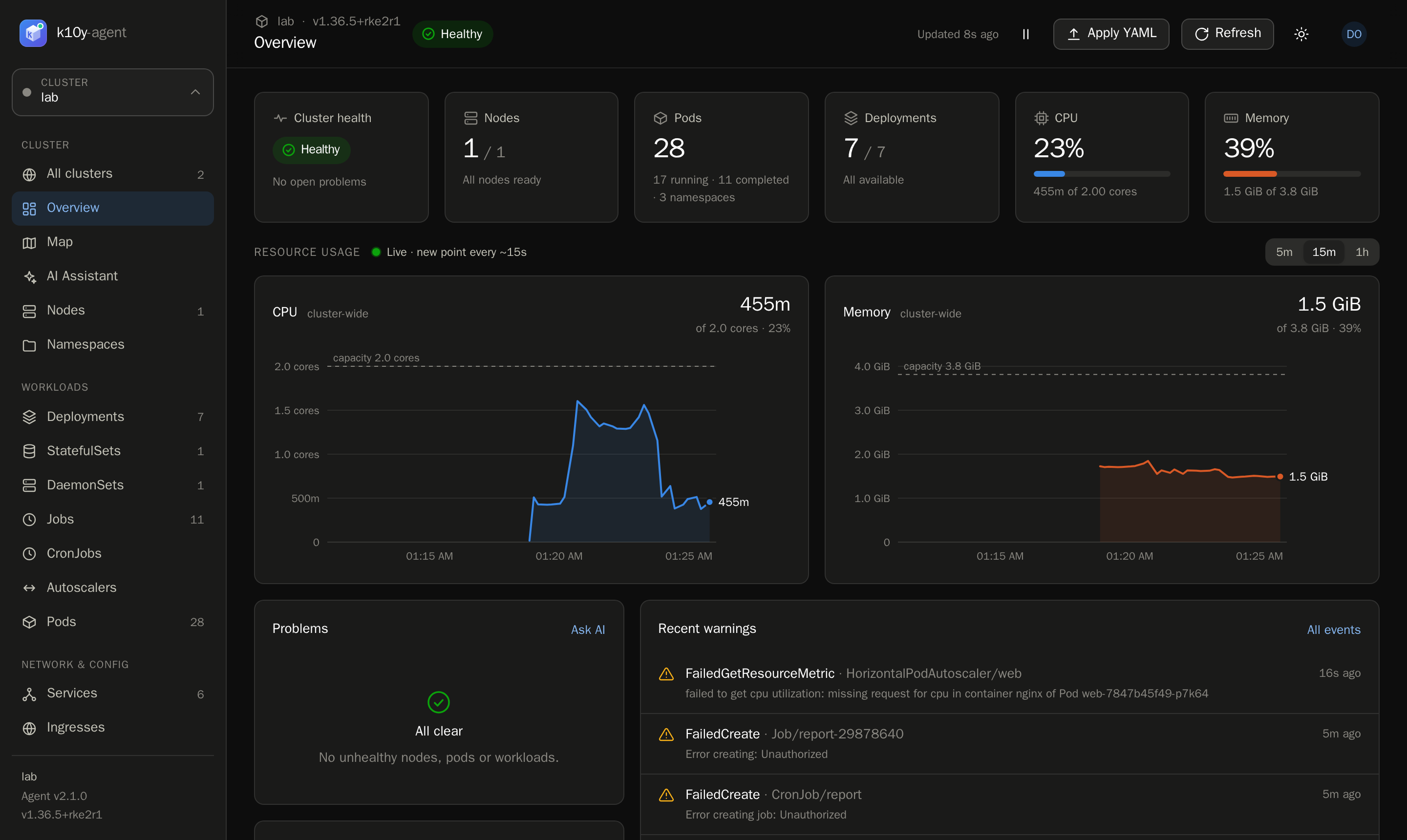
What you can do with it
- See everything: health, problems, live CPU and memory, and every common resource type, from Deployments to PVCs, across all your clusters.
- Troubleshoot fast: live logs for a whole workload, a shell in any container, events, and a relationship map.
- Change things safely: scale, restart, roll back, edit YAML, drain nodes and more. Every action has a dry run, and destructive ones need confirmation.
- Control who does what: custom roles per cluster, with every change recorded against the person who made it.
- Know when something breaks: alert rules with Telegram notifications.
- Ask for help: an AI assistant that investigates with read-only tools and proposes fixes for you to approve.
How it fits together
k10y has two parts:
| Part | Runs | Job |
|---|---|---|
| Hub | Docker Compose on any server, with PostgreSQL | The website people sign in to. Users, roles, cluster connections, audit, alerts and AI live here. |
| Agent | One small pod in each cluster | Reads the Kubernetes API and metrics-server, and carries out actions. API-only. |
People only ever talk to the hub. The hub checks their permissions and forwards each request to the right agent over HTTPS. Read the architecture →
Requirements
- Hub: a machine with Docker and Docker Compose (Linux, macOS or Windows), reachable by your users on one port (8443 by default).
- Each cluster: a recent Kubernetes (developed and tested on 1.36 with RKE2 and k3s; anything with
batch/v1CronJobs andautoscaling/v2HPAs, 1.23+, should work),kubectlwith admin rights for the install, and metrics-server for CPU and memory charts. RKE2, k3s, EKS, GKE and AKS include it. The hub must be able to reach port 30800 on a node. - Images:
docker.io/k10y/k10y-agentfor amd64 and arm64.
Next steps
- Quick start: running in about five minutes.
- Dashboard tour: what each page does.
- Users, roles and permissions: invite your team.